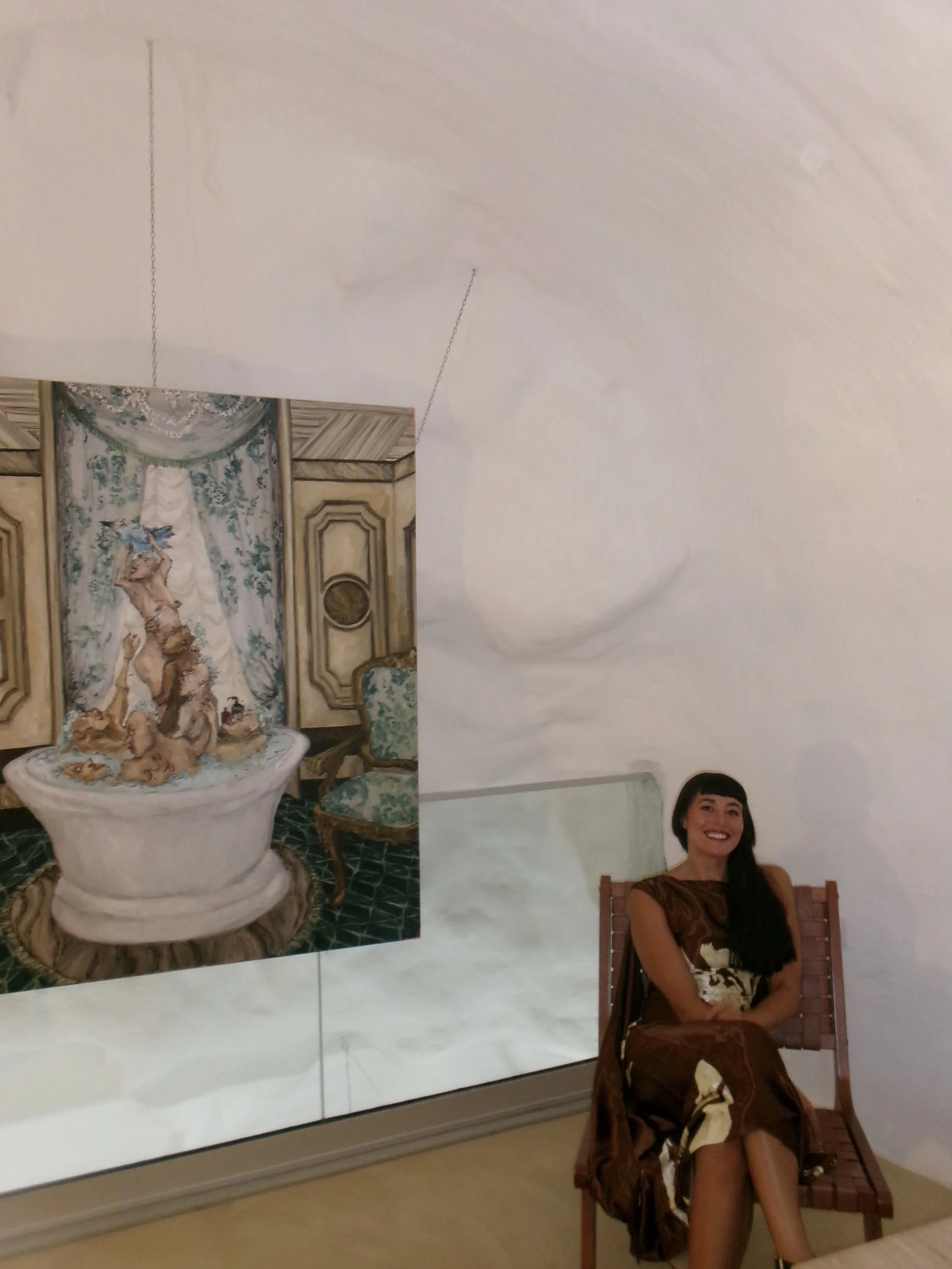
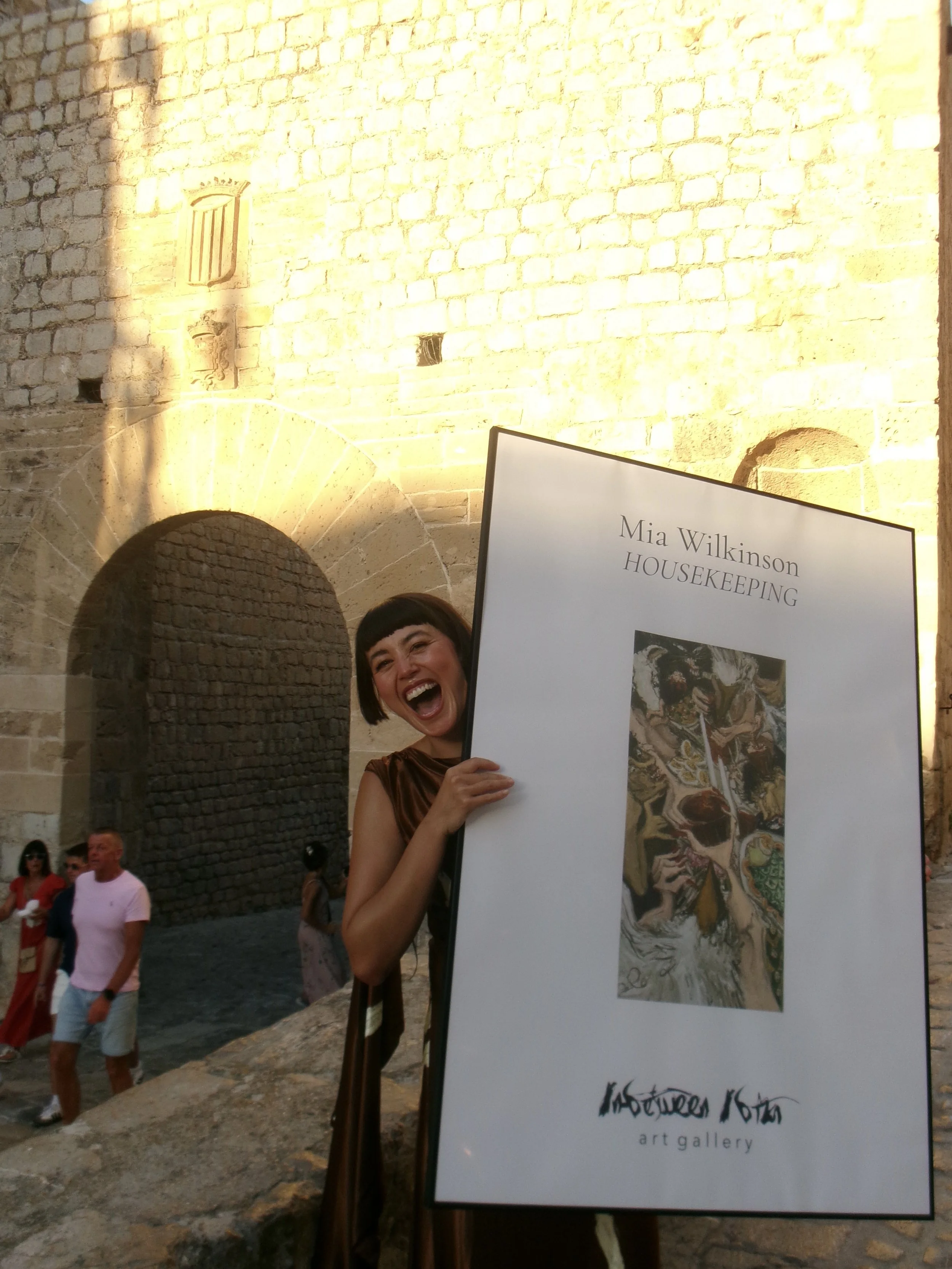
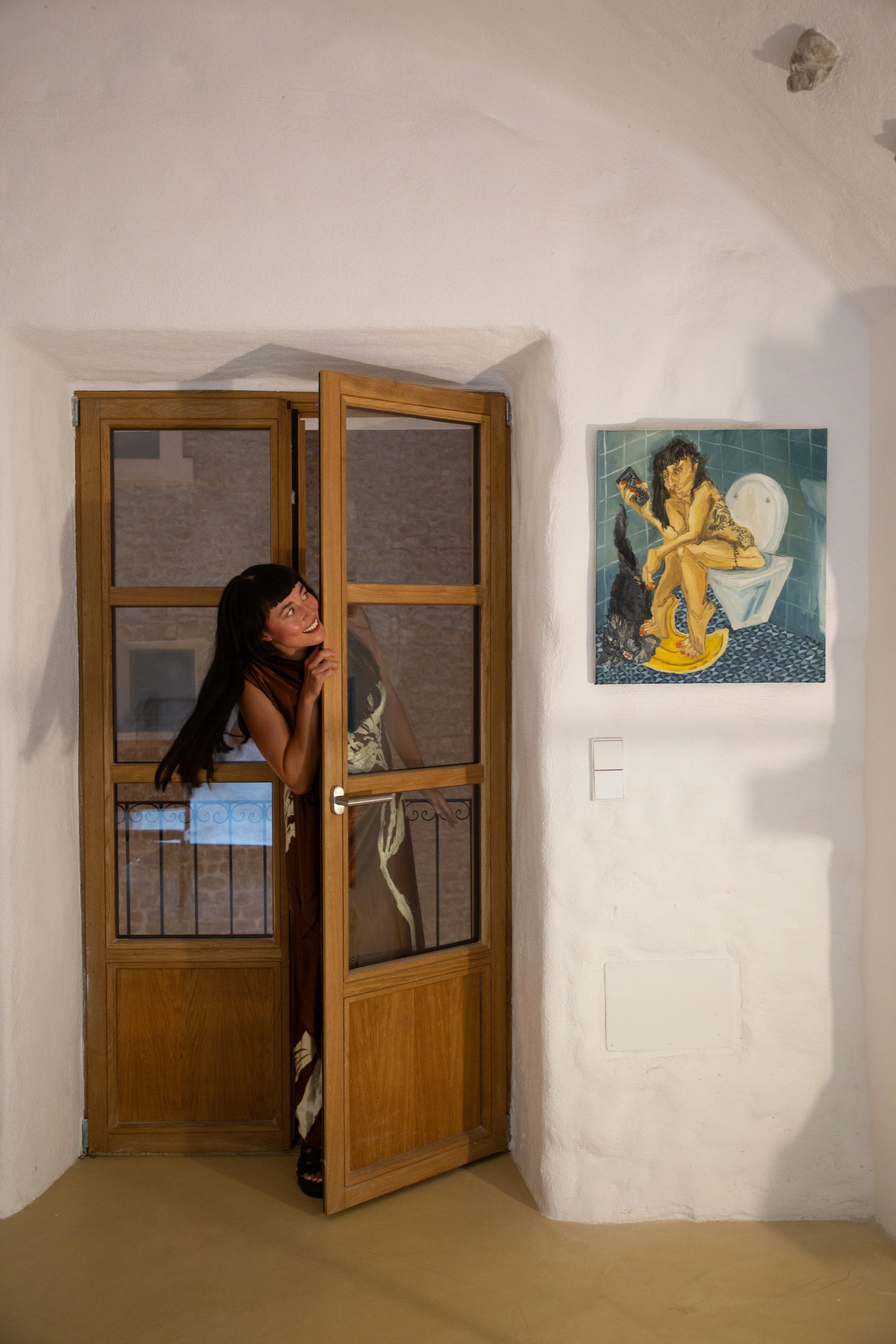
To coincide with HOUSEKEEPING, Mia Wilkinson speaks with In-Between Ibiza about the spaces, bodies and expectations that shape her practice. Working through domestic interiors, humour, excess and self-portraiture, Wilkinson explores the complicated territory between femininity and performance, attraction and discomfort, intimacy and social expectation.
Her paintings transform familiar domestic settings into theatrical worlds where women refuse to remain contained by the roles assigned to them. Drawing from personal history, class, gender and identity, Wilkinson embraces humour as both a point of entry and a form of resistance.
In this conversation, she discusses the home as a stage, the relationship between painting and performance, the influence of her working-class and matriarchal upbringing, and what it means to use her own body as both subject and material.
Interview with Mia Wilkinson
What draws you back to domestic environments?
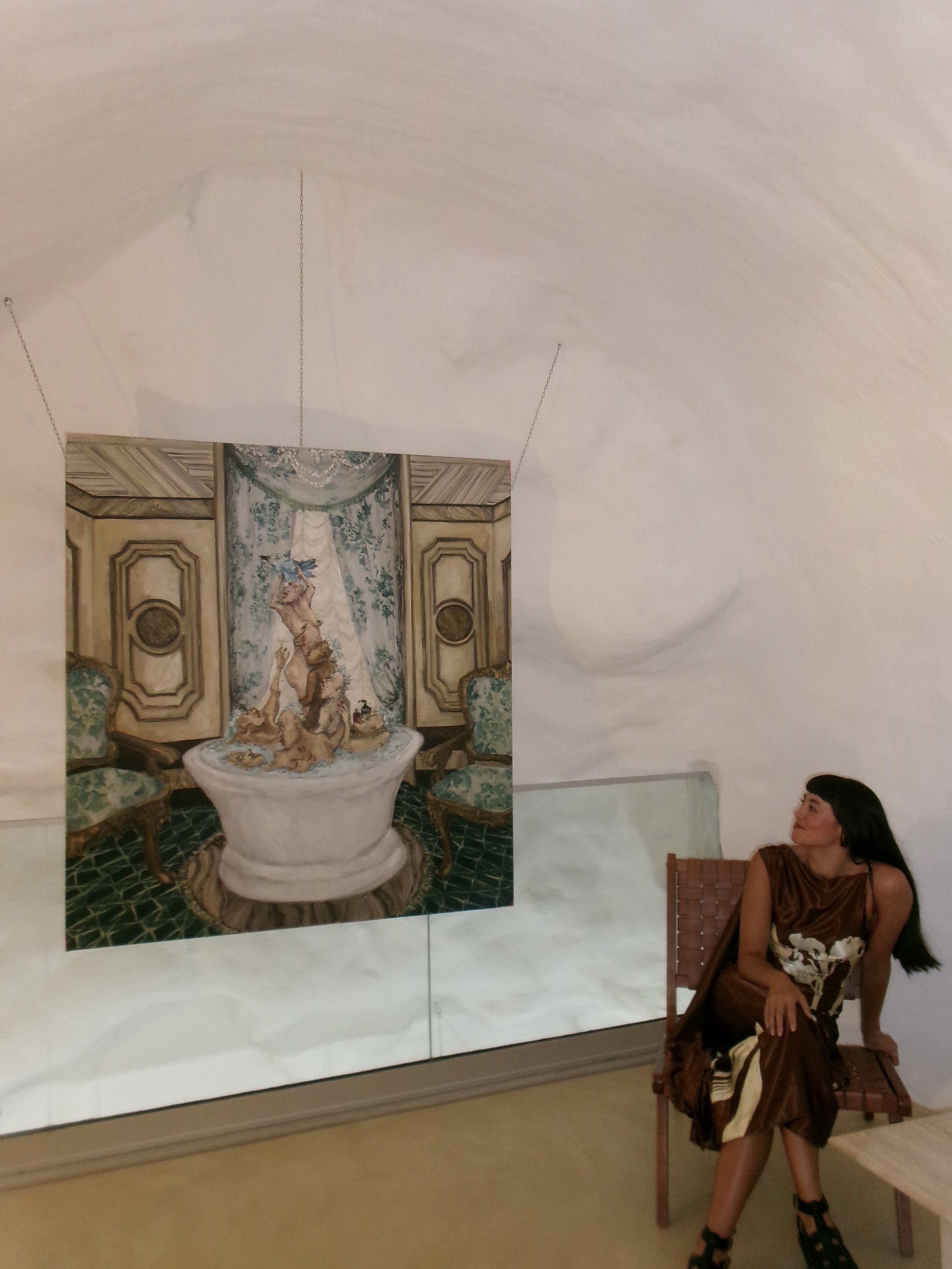
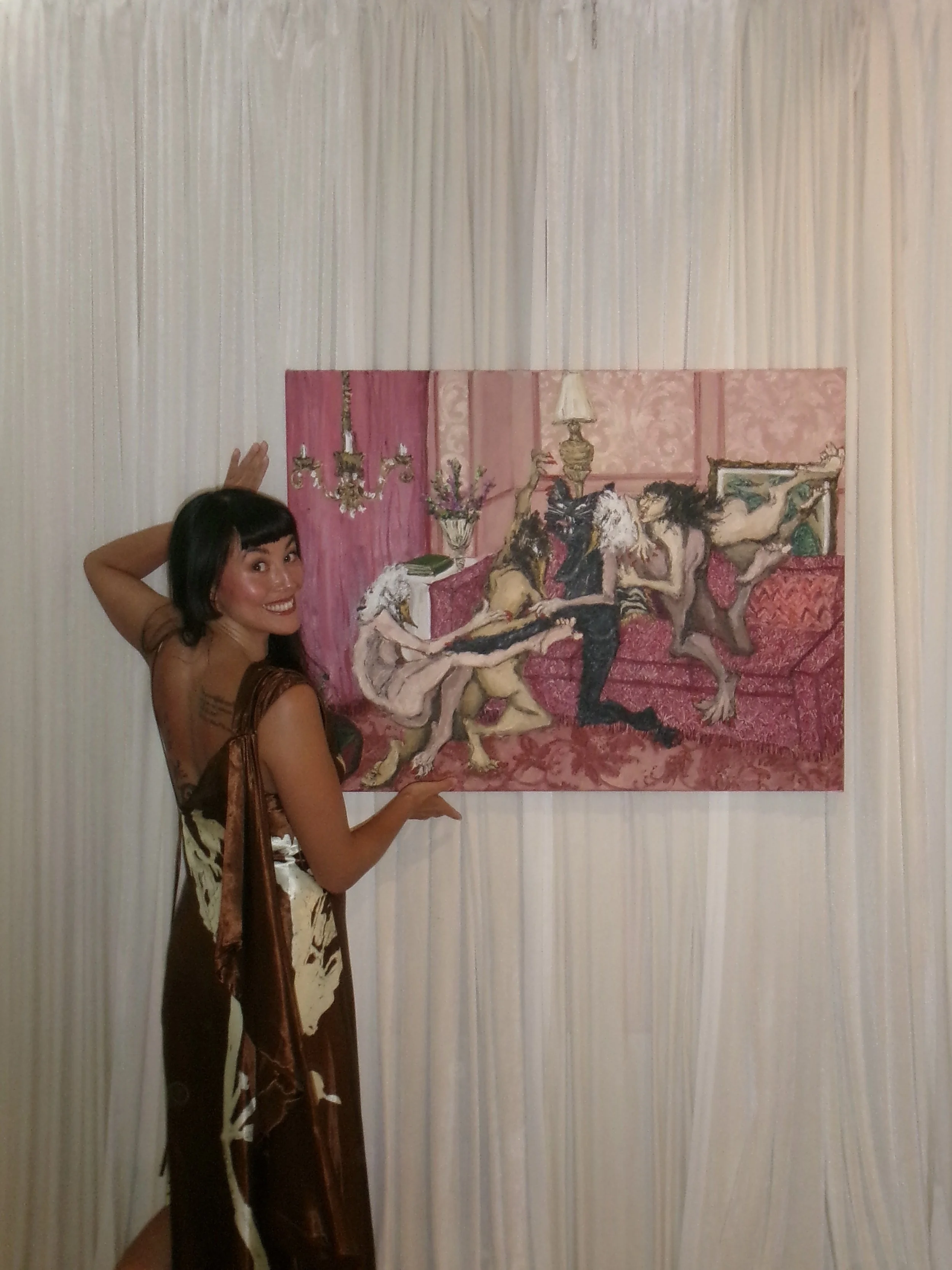
I’m interested in the home because it’s never really neutral. It’s where ideas around gender, labour, class, care and expectation become very ordinary and therefore almost invisible. I like taking those familiar spaces and disrupting them. Kitchens, bathrooms, bedrooms and dining tables become places where the women can misbehave, take up space and make a mess of what is expected of them.
Do you consciously think about the home as a stage?
Definitely. There’s a performance attached to domesticity and particularly to femininity within it. Being a good host, a good mother, a good partner, keeping a nice home, serving people properly. I’m interested in what happens when that performance starts to fall apart. My interiors become quite theatrical because everything is slightly too much: the bodies, food, pattern, colour, behaviour. The house stops containing the women properly.
What role does humour play in your paintings?
Humour is really important because it gives me a way into subjects that could otherwise become very heavy. I use double meanings, slang, bodily humour and absurdity quite instinctively. Titles like Dirty Bird, Silly Cow or Game Birds can be funny, but they also come from language historically used to categorise or diminish women. I like that something can make you laugh and then become slightly uncomfortable once you realise what you’re laughing at.
Are your characters portraits, archetypes or something in between?
Somewhere in between. They often begin with myself or women I know, but I’m not particularly interested in making conventional portraits. They become exaggerated versions of female types I recognise: the hostess, the mother, the promiscuous woman, the woman who takes up too much space. I distort them until they become something more unstable. They’re human, animal, caricature and self portrait all at once.
Has painting become a way of exploring personal history?
Yes, although I don’t think of the paintings as autobiography. Growing up in a very strong matriarchy has inevitably shaped how I understand femininity, labour and power. At the same time, the absence of my Asian father left part of my racial identity quite abstract to me. Those things enter the work indirectly. I’m more interested in what happens when something personal meets wider cultural expectations around women, class and identity.
What does self portraiture allow you to investigate?
It makes me uncomfortable, which is partly why I keep doing it. There’s something strange about being both the person making the image and the body being looked at. Historically women have so often entered painting as subjects for somebody else’s gaze. Using myself lets me interfere with that relationship. I can make the body sexual, ridiculous, awkward, powerful or unattractive without having to make it behave for anyone.
Do you deliberately cultivate the tension between attraction and discomfort?
Yes. I don’t want the paintings to resolve themselves too easily. I like seduction in painting: colour, flesh, pattern, humour, food, excess. But once you’re inside the image, things become less comfortable. Bodies distort, animals and women merge, domestic spaces become claustrophobic. I’m interested in holding attraction and repulsion together rather than deciding which one the viewer should feel.
Does class continue to shape the stories artists are able or expected to tell?
Completely. Class affects who gets to become an artist long before anyone encounters the work. It affects education, time, confidence, language, networks and whether you can afford to keep making work when nobody is paying you to do it. Coming from a working class background in the North East and now making work in London means I’m very conscious of those different cultural codes. I don’t necessarily want to illustrate class, but it inevitably enters how I speak, title things, use humour and understand domestic life.
Do you think painting itself is a kind of performance?
Yes, particularly the way I paint. I don’t want the surface to become too controlled. There’s smearing, scraping, repetition, thick paint and moments where something almost collapses and then gets pulled back. That physical negotiation becomes part of the image. In that sense the painting performs some of the same tension as the women inside it: control against excess.
At what point does an experience stop being yours and become something universal?
I’m not sure there is a specific point. I normally start with something I understand personally and then distort it until it isn’t really mine anymore. I’m not interested in asking the viewer to know my biography in order to understand the work. The personal is more like the raw material. Once it becomes painting, other people bring their own experiences of bodies, homes, mothers, sex, class, shame or humour to it.
What question do you wish people asked about your work, but rarely do?
Probably why the women are allowed to be funny. There’s still an expectation that work about gender, identity or the female body has to communicate its seriousness through solemnity. I’m interested in humour as something much more complicated than relief. It can be crude, defensive, aggressive, classed, sexual and incredibly powerful. Sometimes making something ridiculous is the sharpest way I know to talk about it.
Questions by Leon Plaga