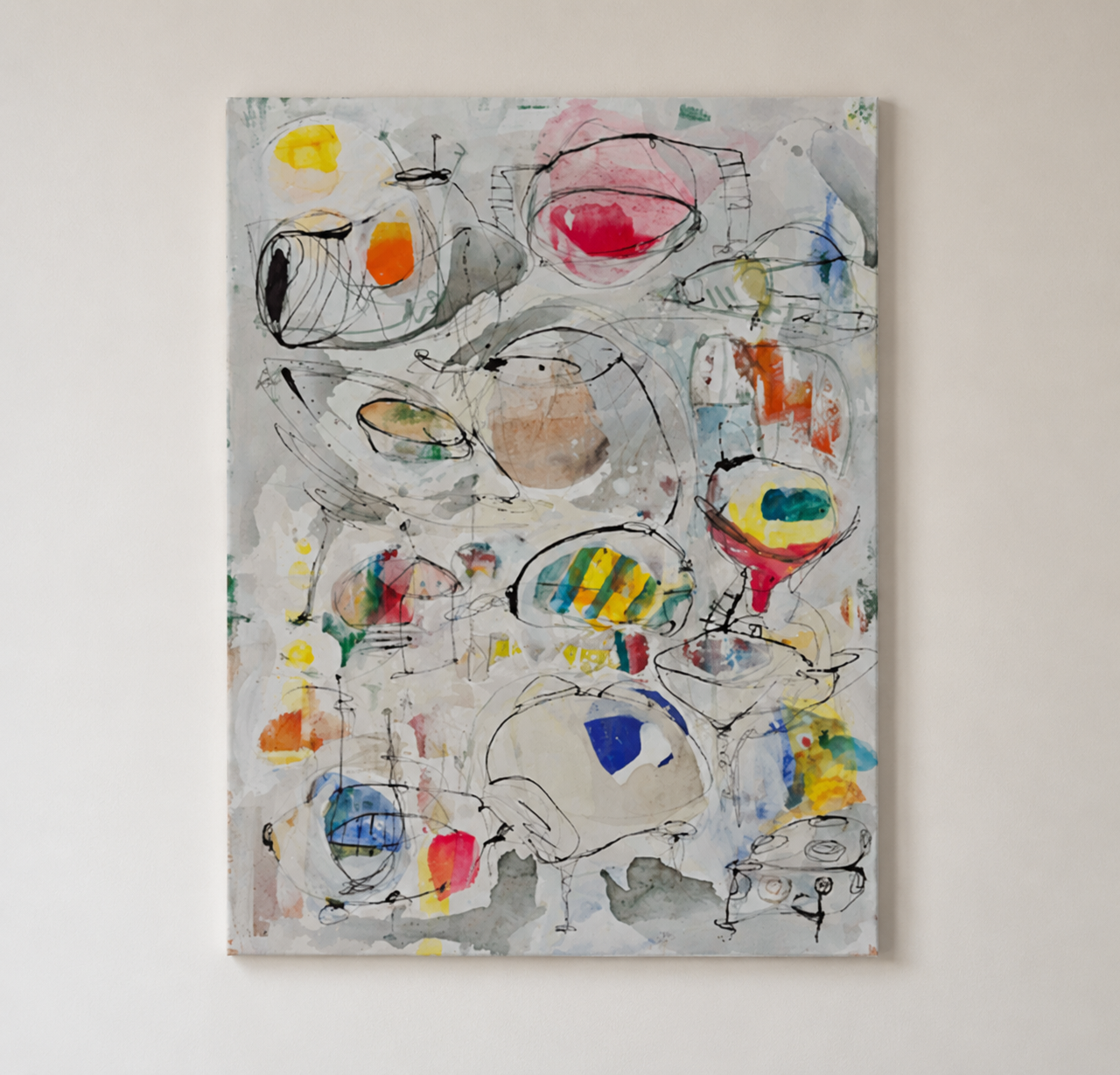
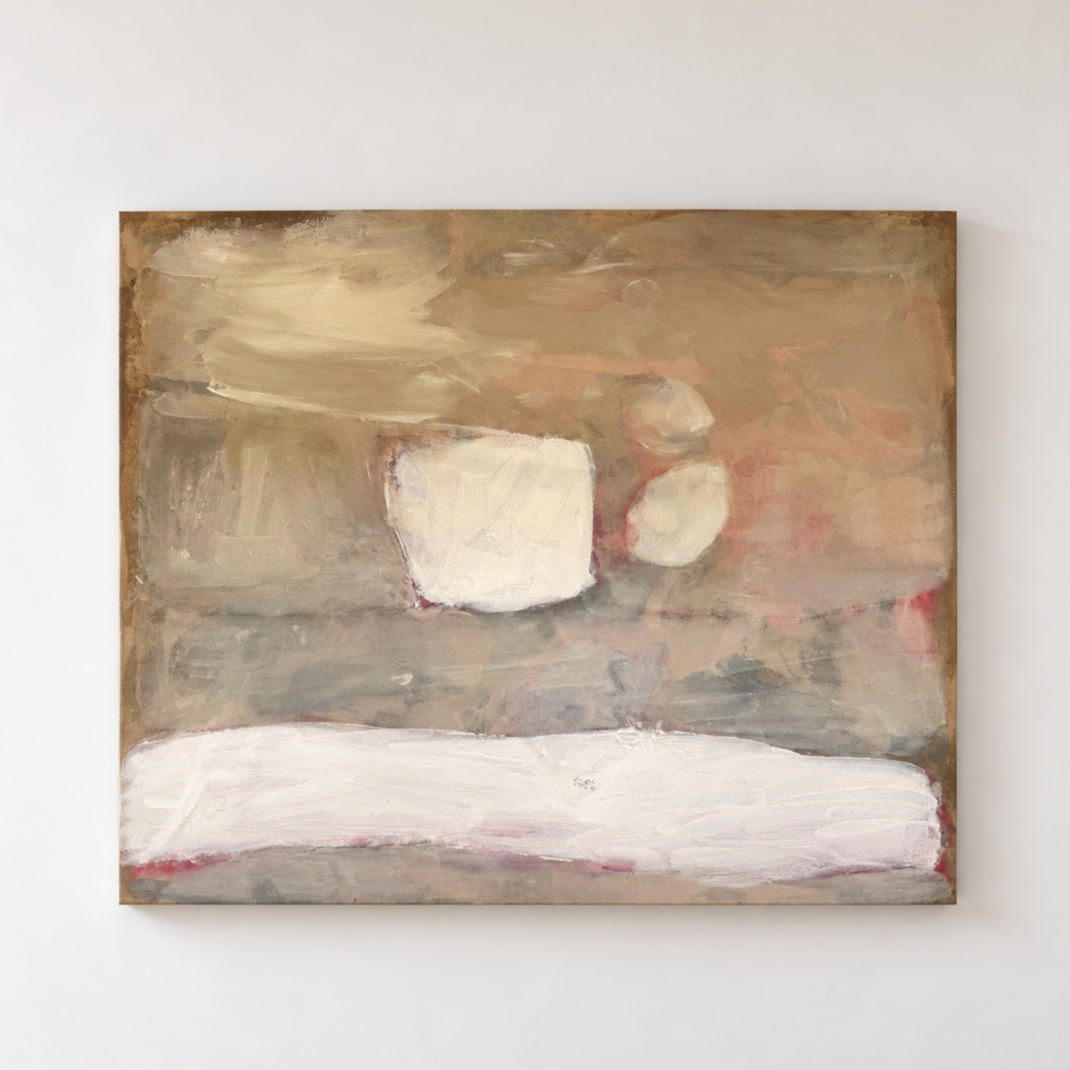
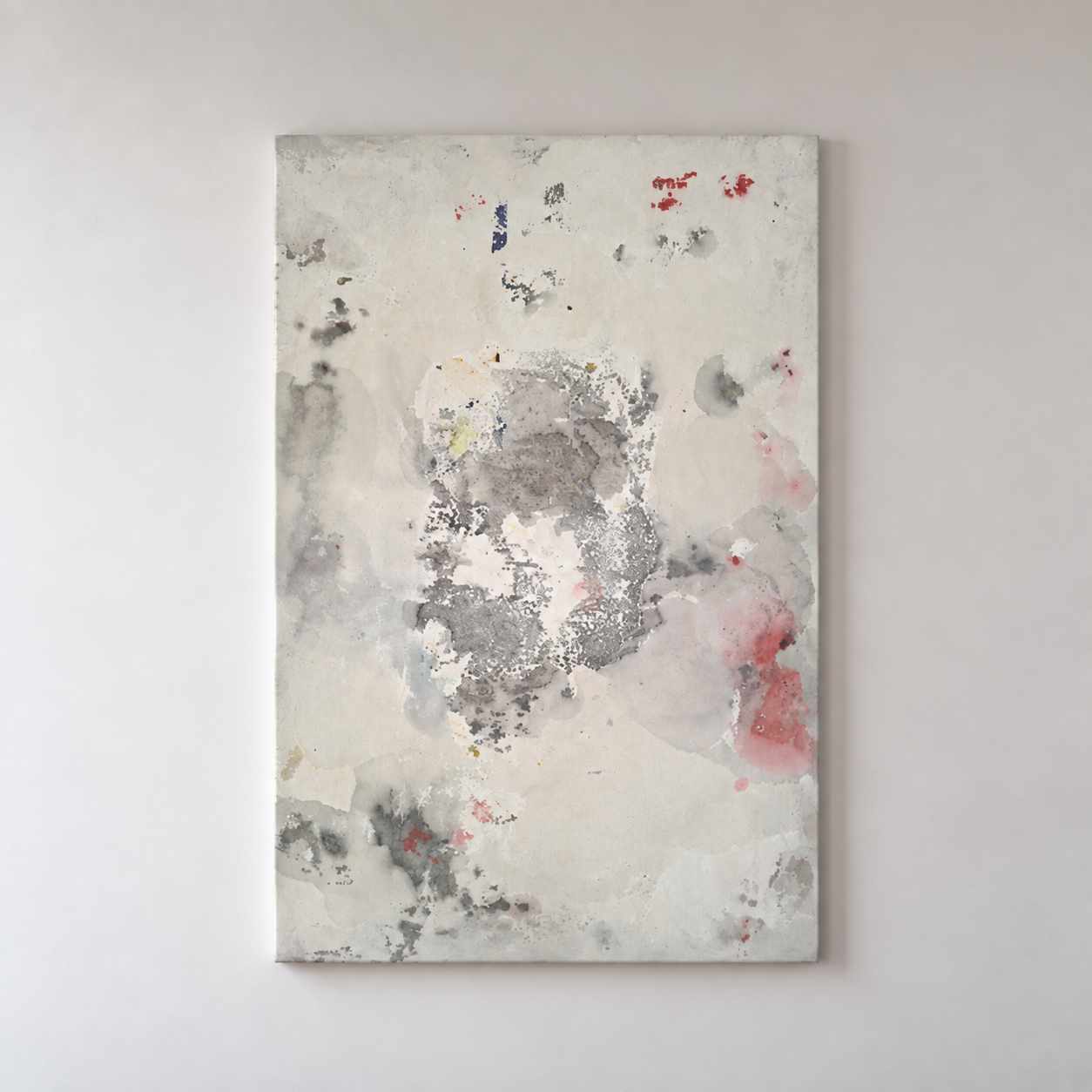
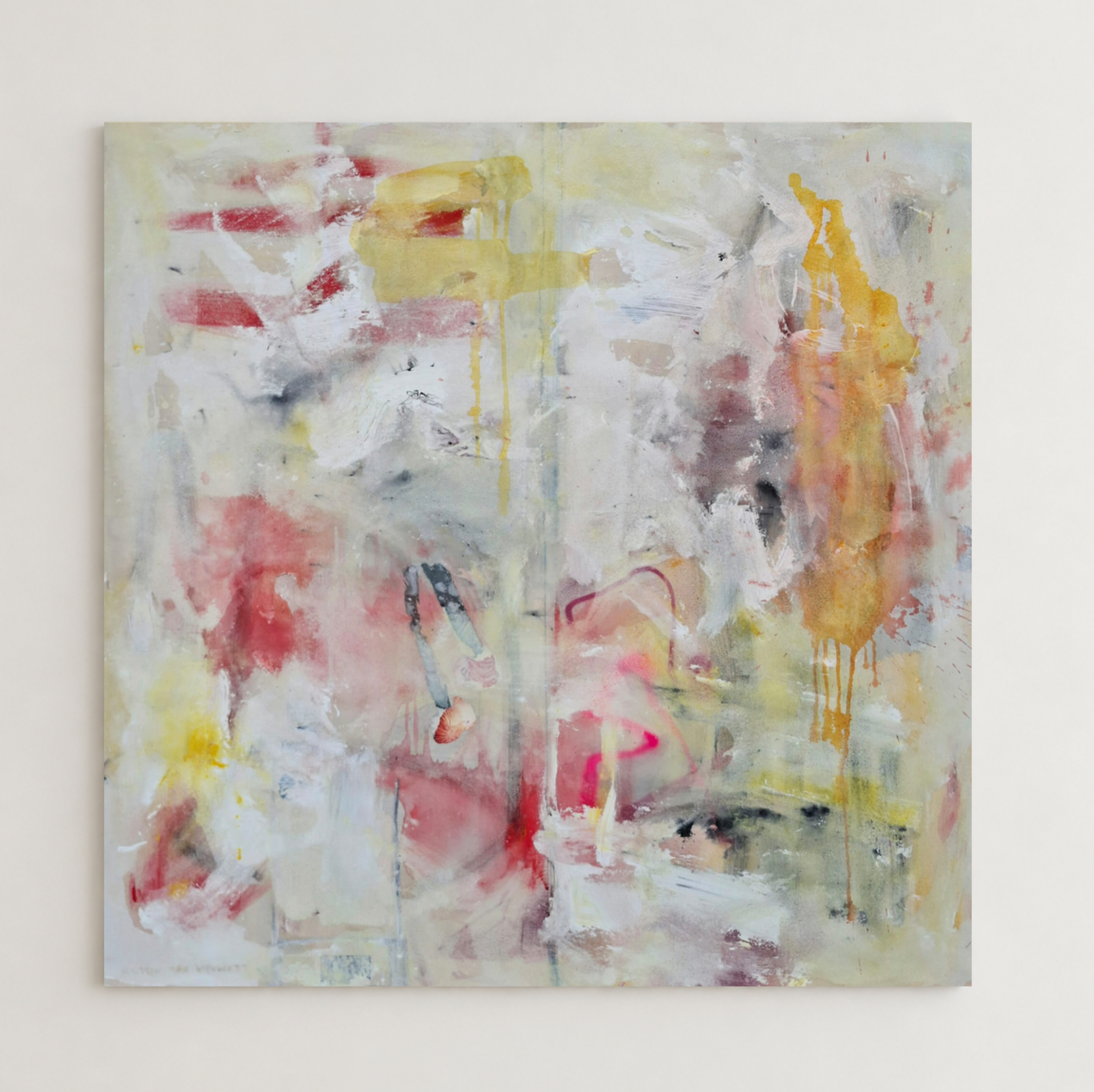
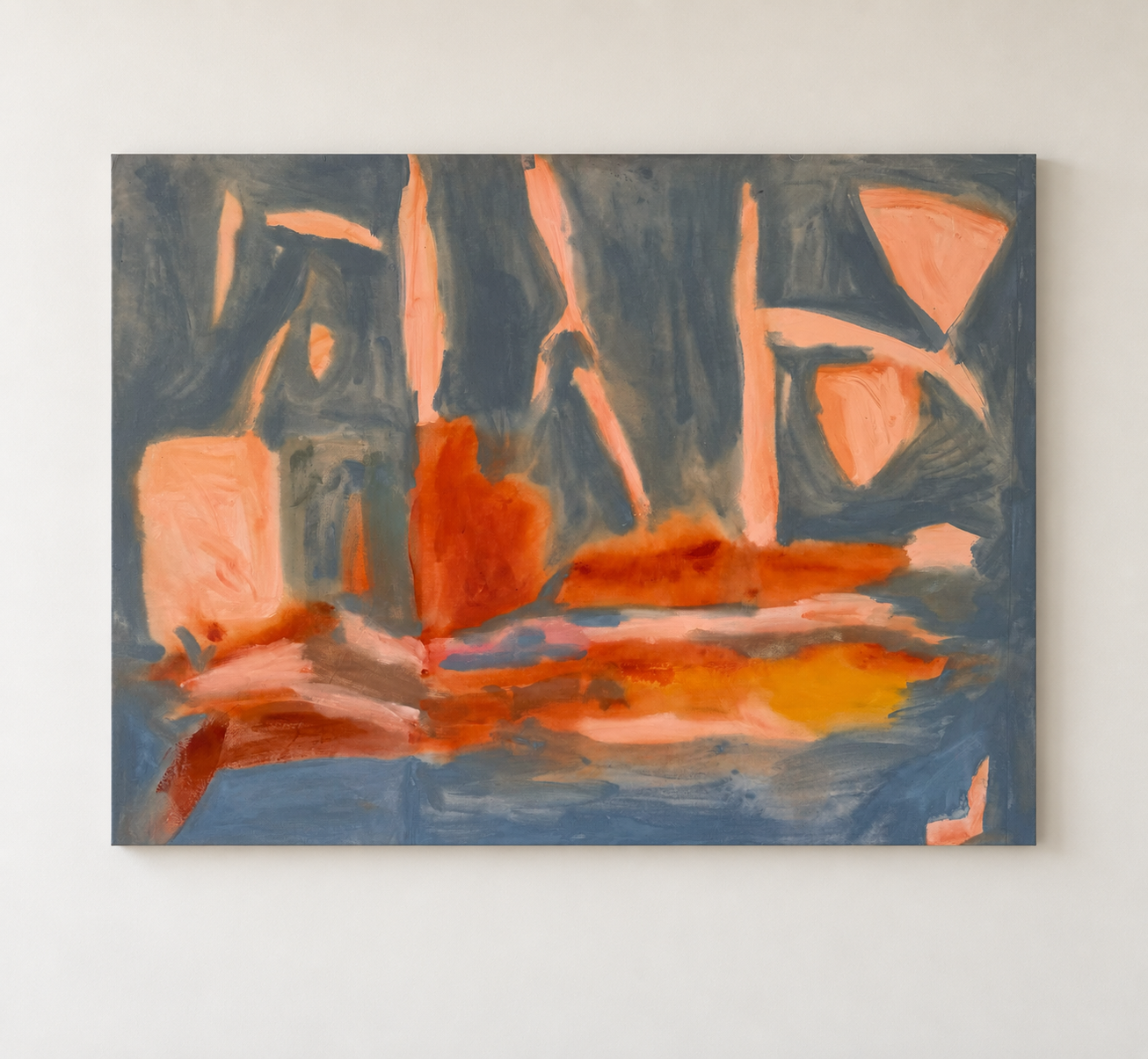
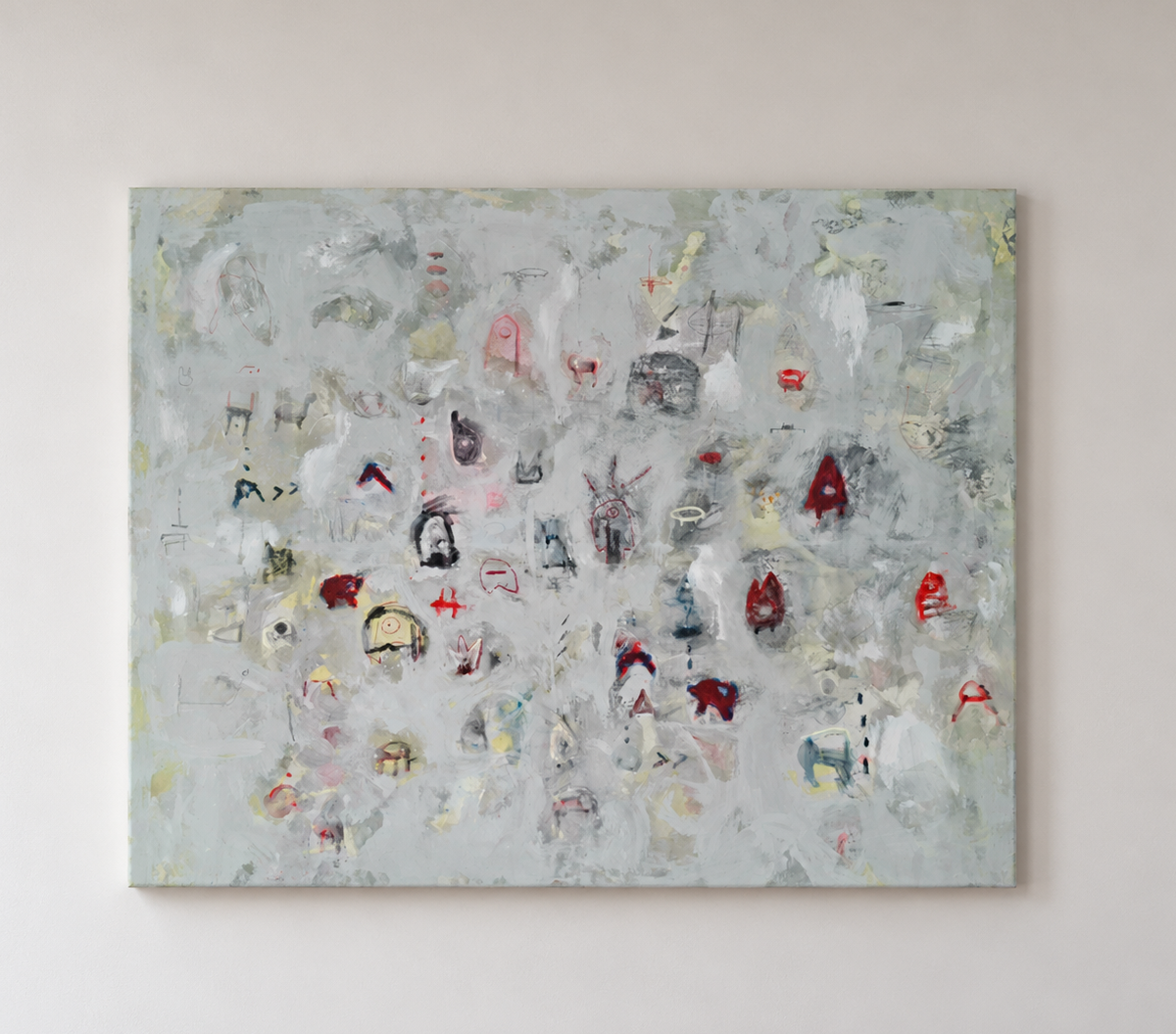
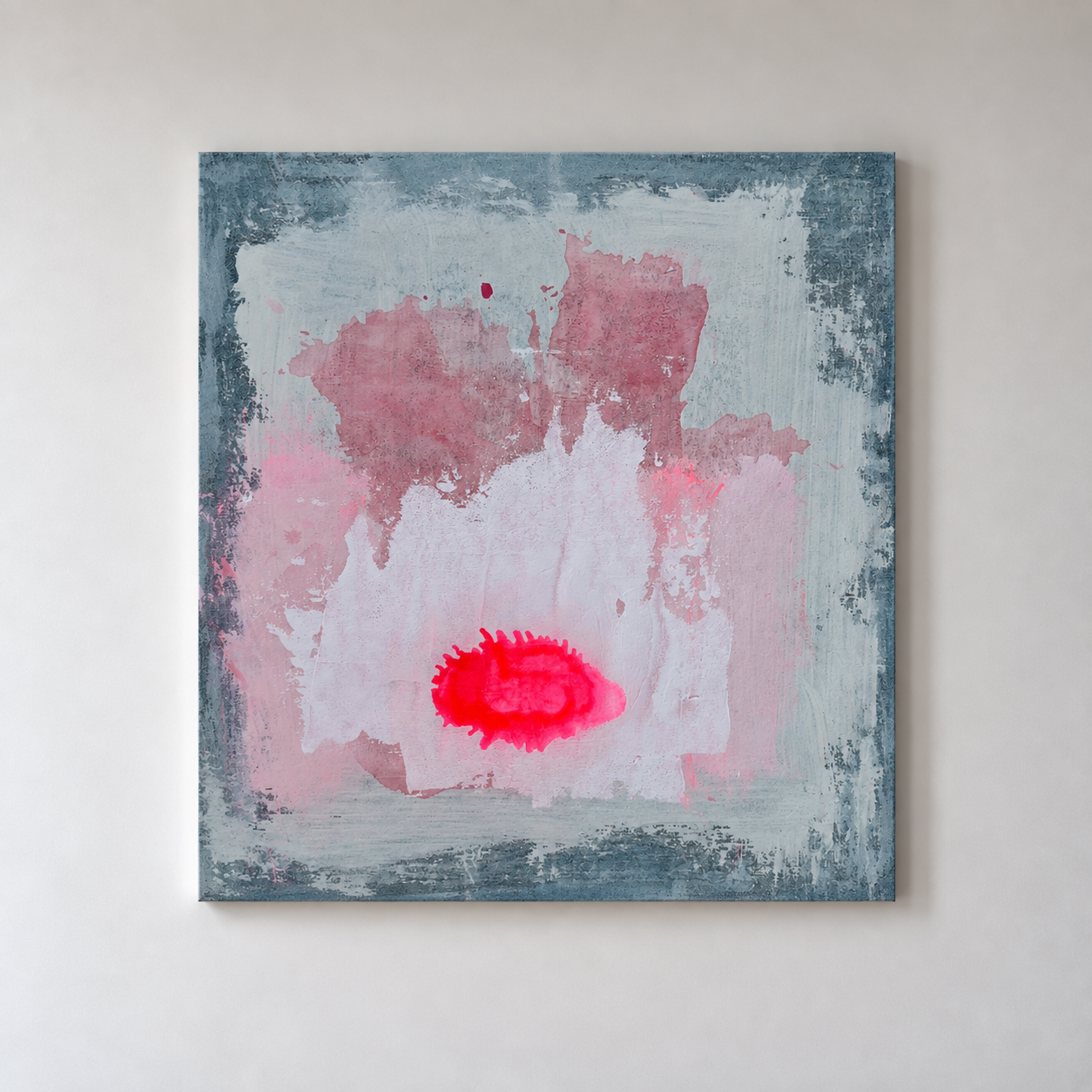
To coincide with their duo exhibition at In-Between Ibiza, Malvina Kang Hughes and Jesús de Miguel reflect on the instincts, references and experiences that find their way into their paintings. Rooted in very different visual languages, their practices share an openness to experimentation, movement and the unexpected, where conscious decisions coexist with intuition and chance.
Both artists speak to the importance of allowing a work to evolve beyond its initial intention. For Jesús, this means looking backwards and forwards at once—to prehistoric symbols, ritual, ancient forms and the recurring impulses that shape human image-making. For Malvina, painting becomes a physical and intuitive process, deeply connected to movement, nature and the environment in which she works.
Together, they discuss Ibiza as both a place of influence and a space of encounter, the relationship between the known and the unlearned, and the moment when a painting stops being something directed and begins to reveal itself.
Jesus de Miguel & Malvina Kang Huhers | In Conversation 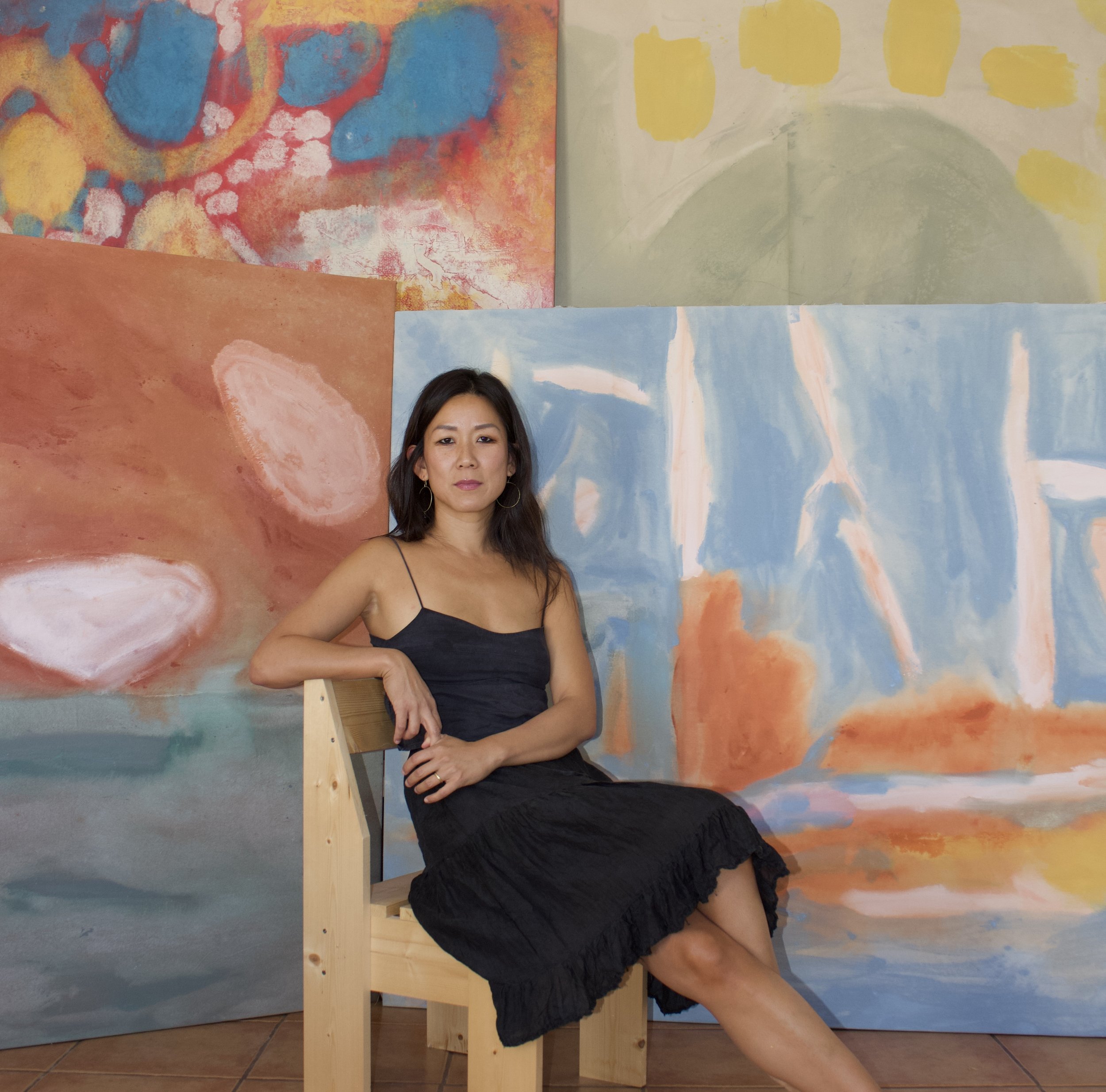
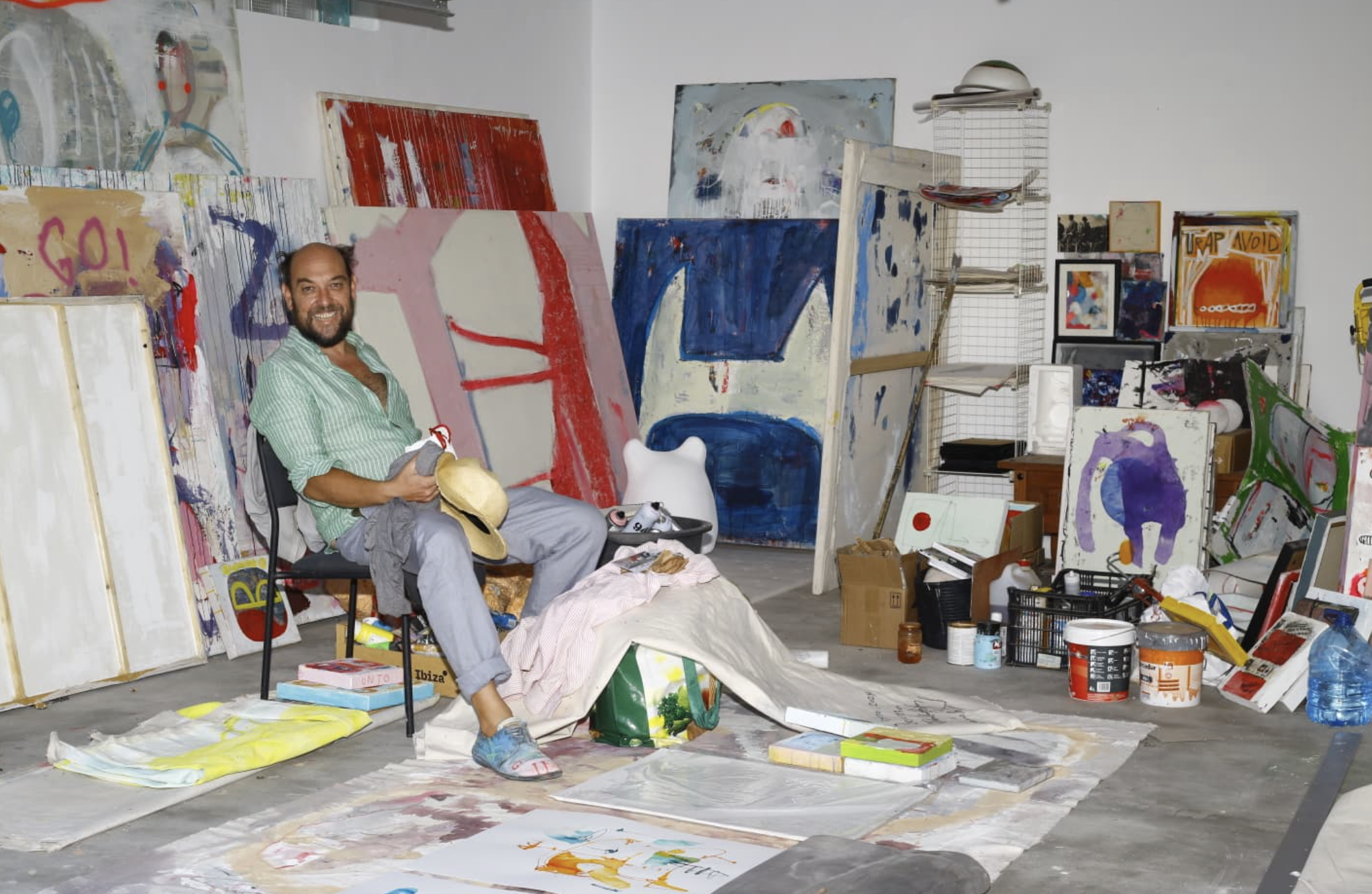
MKH: What was it in your life that inspired you to dedicate yourself to art?
JDM: The fact that you can create beautiful things. That you can build a world.
It happened naturally; I’ve always been interested in seeking out my own references and constructing my own language—a way of looking at things.
Having seen things that caught my attention.
Play is the most serious and sacred form of human activity.
MKH: You have a very deep knowledge of the anthropology of art. Which period or artists have particularly sparked your imagination and changed the way you understand art?
JDM: Ha! Not really...
I’ve always been interested in human error versus technological efficiency. The absurd and the sublime.
But I have been very interested in everything that exists before the concept of "art" came about, and what follows. Early symbols and the future—ritual objects, forms that appear time and again across vastly different cultures.
I am interested in that moment when a form is not yet separated from life.
Later on, of course, there are many artists who have influenced me, but rather than following a specific line, I am interested in finding connections between things that are far apart - specifically, in understanding that images do not appear out of nowhere. They have a history, but they also contain something that repeats, something inherent to the way we imagine things as a species.
MKH: What are your favourite periods in art history, and why?
JDM: That’s a tough one. I am particularly interested in prehistoric art—for that blend of necessity, mystery, and simplicity—and in Romanesque art.
Nefertiti and The Seated Scribe! Dada!
Ah, rather than favorite periods, I think I’m interested in the origins—the "why" behind each distinct era.
Or simply great works from any period. (LIKE EVERYONE ELSE, I IMAGINE)
And, of course, numerous moments in modern and contemporary art. I cannot deny the influence of Expressionism on my work. And Informalism.
Underground movements...and, of course, numerous moments in modern and contemporary art.
And I can't deny the influence of Expressionism on my work. And Informalism.
Underground movements interest me a lot too, of course. Bouncing around and gathering info—data—from any moment.
MKH: Ibiza is a truly unique place, and a large part of your artistic practice has developed on the island. What aspects of Ibiza have been pivotal in your development as an artist and in your work?
JDM: The music. The good weather and the food.
Ibiza is a vital and artistic laboratory.
The number of characters per square meter is magnificent. Seeing how they operate, each with their own dream (and sometimes their own abyss).
A meeting point for so many things: landscape, cultures, spirituality, architecture, music, tourism, tradition, excess, nature... All of that coexists in a very small space. And I think that mix has greatly influenced the way I work.
Ibiza has something very ancient and, at the same time, very contemporary about it.
That coexistence of different eras interests me a great deal.
MKH: Art seems to be the backdrop connecting many of the things you are immersed in: music, gastronomy, culture, cinema, literature, philosophy... How do all these elements influence you and your work?
JDM: Haha... I like them, I pay attention to them, but I’m not immersed in them, nor do I delve too deeply.
I imagine it’s pure—or mere—nourishment; there’s no reflection on the medium itself, though there is on what is being told or invented.
For me, they aren't separate. I’ve never thought, "Now I’m making art because I’m painting." It all falls within the same experience.
Music, rhythm, and repetition.
I’m interested in the things that happen around that.
Most of the time, ideas emerge from something completely unrelated to painting; everything filters through.
MKH: Your paintings are often constructed from primitive symbols, letters, intuitive gestures, and energy-charged strokes. They are an amalgam of the old and the new, of present-moment instinct and anthropological knowledge, of the learned and the unlearned. They play with the paradox of life and the harmonisation of many converging forces. Do you agree with this interpretation? Where do you place yourself amidst all these convergences in your work? How does all this manifest in your way of painting?
JDM: Yes, I think there is a lot of that, although perhaps I don't think about it quite so consciously while I'm painting.
Perhaps a simple explanation: the painting as the final result of everything you do or absorb. And above all, I treat it as a game (decontextualization, exaggeration, boundaries).
I am very interested in that moment when you begin to recognise something without knowing exactly what it is.
There is a part of my painting that comes from all the images I’ve accumulated, but there is another part I try to keep unlearned—to let it simply emerge.
That’s why I’m so interested in the contradiction between what we know and what we don’t know; between constructing an image and letting the image construct itself. I suppose I paint somewhat from that middle ground—hoping that the people looking at the work will complete it within their own worlds.
MKH: Although your paintings have an abstract character, I perceive that composition, form, symmetry, and proportion play a significant role. Do you keep these elements in mind while working? And at what point do you give way to intuition and instinct?
JDM: Yes, composition is very important to me, even if it isn't always immediately apparent.
Some paintings begin in a very intuitive way, while others start with a fairly clear structure. But even when a structure exists, I try to ensure it doesn't become too rigid or closed off.
I am fascinated by that moment when a painting begins to take on a life of its own, and you no longer quite know who is leading whom. That’s when things get interesting. For me, intuition doesn't mean painting without thinking. It is, rather, a different way of thinking—faster and less verbal. Sometimes you know something works—or doesn't—before you can explain why.
MKH: What would you say to your younger self, just starting out on the path as an artist?
JDM: I suppose the basics... to listen and show respect. Or nothing at all!
MKH: Although your paintings have an abstract character, I perceive that composition, form, symmetry, and proportion play a significant role. Do you keep these elements in mind while working? And at what point do you give way to intuition and instinct?
JDM: Yes, composition is very important to me, even if it isn't always immediately apparent. Some paintings begin in a very intuitive way, while others start with a fairly clear structure. But even when a structure exists, I try to ensure it doesn't become too rigid or closed off.
I am fascinated by that moment when a painting begins to take on a life of its own, and you no longer quite know who is leading whom. That’s when things get interesting.
For me, intuition doesn't mean painting without thinking. It is, rather, a different way of thinking—faster and less verbal. Sometimes you know something works—or doesn't—before you can explain why.